
Tri-County Science scores soar past state average; Math Near State Level
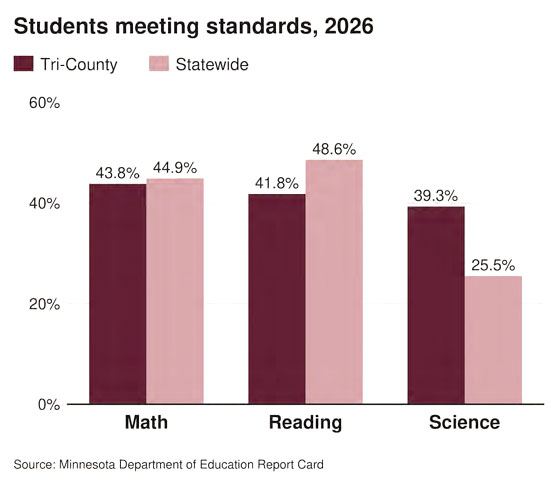
Tri-County School students posted science scores well above the statewide average on last spring's state tests, while math results came in just shy of the state average, according to new data from the Minnesota Department of Education.

The figures, posted on the state's online School Report Card, show the Karlstad-based district's biggest gain in science. This year, 39.3 percent of Tri-County students tested in science — 11 students — met or exceeded state standards, up from 20.9 percent (9 students) in 2025. Statewide, 25.5 percent of students met the science standards, putting Tri-County nearly 14 percentage points above the state average.

The state began new science assessments in 2025, so only two years of comparable data exist. Science is tested in fewer grades than math and reading, and with a small number of students tested, a change of just a few students can move the percentage noticeably.

In math, 43.8 percent of Tri-County students — 35 students — met the standards, about 1 percentage point below the statewide rate of 44.9 percent.

That was down from the past two years, when Tri-County topped the state in math. In 2024, 51.1 percent of Tri-County students met the math standards, compared with 45.5 percent statewide, and in 2025, 48.9 percent met the standards, compared with 45.2 percent statewide. The district's math rate was 43.3 percent in 2022 and 41.5 percent in 2023. Statewide math results have stayed nearly flat at about 45 percent over the past five years.

In reading, 41.8 percent of Tri-County students — 33 students — met state standards, compared with 48.6 percent statewide, a gap of about 7 percentage points. Minnesota introduced new reading assessments in 2026, so this year's reading results cannot be compared with earlier years.

The Report Card also shows Tri-County well ahead of the state in attendance. In 2025, 85.8 percent of the district's students were considered consistently attending — in school more than 90 percent of the time they were enrolled — compared with 76.5 percent statewide.

In a 2025 student survey, 88.6 percent of Tri-County students who responded agreed or strongly agreed that teachers at their school care about students, compared with 90.8 percent statewide. Seventy students answered the question.

Tri-County's graduation rate was 100 percent in 2025, with 12 students graduating, compared with 84.9 percent statewide. The district also posted 100 percent graduation rates in 2021 and 2023. The state did not publish a 2024 graduation rate for Tri-County.

The full Tri-County School District report, including results by grade and student group, is available on the Minnesota Report Card website at rc.education.mn.gov.
The Seasons of Football Friendship
BY NAOMI DUNAVAN, SPECIAL TO THE EXPONENT
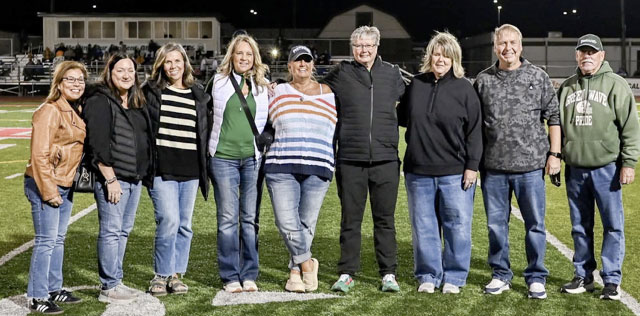
Forty-some years ago, they spent a lot of time in the weight room. Along with body building, team members noticed their friendships were gaining strength as well.

“When you spend every Friday night battling alongside your football brothers,” Dave Vonesh said, “you develop a bond that makes you never want the season to end. We had a great group of guys who shared a common goal. I also give credit to our coaches who pushed us, held us accountable, and helped bring out the best in us.”

Football seasons come and go, but the season of friendship remains steadfast among these players, who as high school seniors were on the 1985 East Grand Forks Green Wave Football Team. Members of that squad were recognized for their 41-year-old stats during halftime of the Oct. 10 home football game.

The 1985 team, “put together one of the great seasons in East Grand Forks Green Wave football history,” the announcer told the spectators. “But what really stands out is the way they played defense.”

The team finished with 11 wins and only two losses. It had eight shutouts and allowed just 65 points for the season. That year, the team was also Section 8A champ and it advanced to the Class A State Semi-Finals.

These men are proud of that, for sure, and they welcome any and every opportunity to return to home turf.

“High school is a special time where the little things are the big things,” said Steve Miller, who was manager/athletic trainer of the 1985 team. “I was the guy who taped all the ankles. High school is a time that can be very confusing, but football brought us all together.”

Former head coach Gary Berg and former assistant coach Dave Hennings joined team members on the field that night. “It was great to be able to shake their hands,” Gary said, “to talk to them and to rekindle some of the good that happened in the past.”

Dave Hennings added, “Some I hadn’t seen in 30-plus years. They’ve been a close-knit group, while playing and then beyond that.”

Kelly Gonsorowski recalls the team’s “respect for our coaches and just knowing we had each other’s backs,” he said. Plus, he can speak, word for word, the locker room message after one of their devastating losses.

“Coach Berg said, ‘I know this hurts right now, but you will encounter things in your lifetime that will make this moment look small.’ And he was so right.”

For Dean Dunavan, life lessons learned while playing Green Wave football, “were and remain huge,” he said. “Of course you don’t know it at the time. But hard work, friendship, discipline, winning and losing with integrity are all a part of playing the game. It’s about being a team. I remember working so hard in the off season to get bigger and stronger because I wanted so badly for us to be awesome and I wanted to play my part.”

Bruce Nelson considers it “a privilege” to have been a member of the 1985 team. “The one thing I will cherish forever is the friends I will have for the rest of my life,” Bruce said. “The memories of that year will also last forever.  We had a special group of players and coaches that worked very hard to achieve what that team did.”

Steve recalls individual players encouraging one another. “It was an amazing group of guys who wanted to do their best,” he added. “I think the fear of not making a play and letting your teammates down was a strong motivation for giving 100%.”

And now, these 40-plus years later, Dave teaches and coaches at Valley Middle School in Grand Forks. Bruce is assistant principal at East Grand Forks Senior High. Kelly, of Esko, Minn., is Highway Maintenance Supervisor for St. Louis County. Steve is Manager of Patient Experiences for Gundersen Region Bellin and Gundersen Health System in La Crosse, Wi., and Dean is a pastor in the Twin Cities.

The camaraderie and connection that lives on in these former players “were formed by hard work and slamming into each other,” Dean said. “It was so incredibly fun. It’s interesting how so much time can pass, and big life events can happen, and yet when I’m with my high school friends now, there is a bond that is unlike any other.”

Other members of the 1985 team who attended the Oct. 10 recognition and the reunion that followed in the East Grand Forks VFW were Troy Ausmus, Steve Bakken, David Bies, Chad Grassel, Tom Hagen, Todd Innes and Dan King.
No Medicare Advantage plans will be offered in Lake of the Woods County Next Year
Julie Bergman, Editor
Lake of the Woods County seniors who get their Medicare coverage through a Medicare Advantage plan will lose that coverage at the end of the year. No insurance company will offer an Advantage plan in the county for 2027.

The county is one of only three in Minnesota, along with Crow Wing and Wadena, where neither Medicare Advantage nor Medicare Cost plans will be available next year, according to the Minnesota Board on Aging. Residents there will have Original Medicare as their only base option.

Statewide, an estimated 392,000 of Minnesota’s 1.2 million Medicare enrollees will lose their current coverage for 2027 as insurers reduce or end their Advantage plans.

Locally, the biggest change comes from Blue Cross and Blue Shield of Minnesota, which offered all of the most popular Advantage plans in the county. Federal records show four Blue Cross plans sold in the county this year, Choice, Complete, Core and Comfort, will be discontinued statewide. A fifth, Freedom Blue, will continue elsewhere in Minnesota but is leaving Lake of the Woods County. About 560 county residents were enrolled in just three of those plans this year.

Blue Cross said it lost about $500 million on its Medicare Advantage business over the past three years.

Maureen Schneider, who chairs the Minnesota Board on Aging, called 2027 a critical year for people on Medicare. She urged them to make decisions before the Dec. 7 deadline so their coverage is in place by Jan. 1.

What is Medicare Advantage?
A Medicare Advantage plan, also called Part C, is offered by a private insurance company and replaces Original Medicare. These plans often bundle prescription drug coverage with extras such as dental, vision and hearing benefits, and they typically use provider networks and copays.

With Advantage plans gone, local seniors will rely on Original Medicare, which covers hospital care (Part A) and medical care (Part B). Many people pair it with a Medicare Supplement policy, which helps pay costs Medicare does not cover, and a separate Part D prescription drug plan. Medicare Supplement policies remain available in every Minnesota county, including from Blue Cross.

What to Do Now
Medicare’s annual open enrollment period runs through Dec. 7. Coverage chosen during that window begins Jan. 1.

Under Minnesota law, people whose Advantage plan is ending can buy certain Medicare Supplement coverage without answering health questions until March 4, 2027. Applicants must show proof of the plan’s end date, so seniors should keep the termination letter from their insurer. Applying before Dec. 31 avoids a gap in coverage.

Schneider recommends that people compare plans carefully before choosing. Key questions include whether their doctors and preferred pharmacy accept the plan, whether their prescriptions are covered and what they will cost, and what premiums and out-of-pocket costs they can expect.

Minnesota Aging Pathways, formerly the Senior LinkAge Line, offers free, unbiased Medicare counseling. It is open weekdays from 8 a.m. to 4:30 p.m. and can be reached at 1-800-333-2433 or through online chat at mn.gov/aging-pathways. Medicare can be reached at 1-800-633-4227.